PerformYard vs Lattice pricing is a published range against a published rate card. PerformYard prints $5 to $15 per person a month for each of its two products, billed annually, with onboarding, training, a dedicated success manager, HRIS integrations and SSO included and no minimum stated on its pricing page. Lattice prints exact module rates, $10 a seat for Performance, $8 for Goals and OKRs, $4 for Engagement and $13 for its Foundations bundle, over a $4,000 minimum annual agreement. So Lattice tells you the price and PerformYard tells you the bounds, and the work for a buyer is finding out where in a range three times wide your own quote will land.
performyard.com/pricing and lattice.com/pricing were both read on 19 October 2026. Every total below is our arithmetic: a published rate multiplied by headcount and twelve months, with Lattice's floor applied where it binds. PerformYard does not publish what places a buyer at $5 or at $15, so its figures are shown as the low and high ends of its own range, never as a price for your company. Neither vendor gave us a quote and neither is affiliated with us.
Is PerformYard cheaper than Lattice?
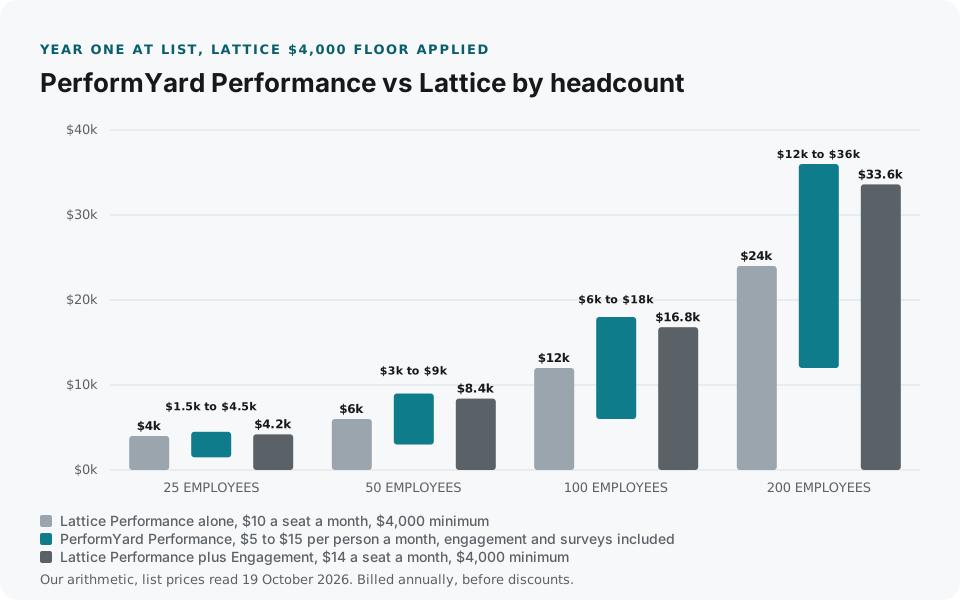
At most sizes it depends on where your PerformYard rate lands, and the break-even is $14. PerformYard's Performance product lists reviews, goals, feedback, meetings, engagement and surveys in one range. Lattice sells Engagement as a separate $4 module next to Performance at $10, so the like-for-like Lattice line for a company that wants reviews and engagement surveys is $14 a seat a month. The top of PerformYard's range is $15. At list, then, the two are within $1 a seat of each other at the high end, and PerformYard is cheaper anywhere below $14, by our arithmetic.
| Headcount | PerformYard Performance, $5 to $15 a person (our arithmetic) | Lattice Performance alone, $10 a seat (our arithmetic) | Lattice Performance plus Engagement, $14 a seat (our arithmetic) |
|---|---|---|---|
| 20 employees | $1,200 to $3,600 | $4,000 (the floor binds; the card says $2,400) | $4,000 (the floor binds; the card says $3,360) |
| 25 employees | $1,500 to $4,500 | $4,000 (the floor binds; the card says $3,000) | $4,200 |
| 50 employees | $3,000 to $9,000 | $6,000 | $8,400 |
| 100 employees | $6,000 to $18,000 | $12,000 | $16,800 |
| 200 employees | $12,000 to $36,000 | $24,000 | $33,600 |

Read the PerformYard column as two edges, not as a price. Nothing in the middle of that range is a PerformYard figure either. If your quote comes back at $8 a person, a 100-person company pays $9,600 a year against $16,800 on Lattice for reviews plus engagement. If it comes back at $15, the same company pays $18,000, which is $1,200 more than Lattice. Those two outcomes are both inside the range PerformYard prints, and that is the whole difficulty of comparing the two at list.
One more line belongs in the comparison. PerformYard's Performance card also lists goals, while Lattice sells Goals and OKRs as its own module at $8 a seat, and Lattice's FAQ confirms Performance and Goals and OKRs can be bought separately. If you want Lattice's goals module as well, the Lattice line rises to $22 a seat a month, by our arithmetic, so ask Lattice which goal features already sit inside Performance before you add it.
How much does PerformYard cost per employee?
PerformYard costs $5 to $15 per person a month for each product, which is $60 to $180 per person a year by our arithmetic. There are two products. Performance covers reviews, goals, feedback, meetings, engagement and surveys. Talent Development, its new suite, covers compensation, coaching, competencies, succession planning, employee insights and career pathing. Both include PerformYard AI, which the page describes as an AI-first conversational interface for creating your performance process.
The pricing FAQ says PerformYard is priced on a per-seat model, billed annually, and that costs vary with the number of employees and the products selected, with volume pricing available for larger organizations. It does not say where volume pricing begins or what it does to the rate. The full breakdown, with year-one totals at 50 to 500 employees for one product and for both, is on our PerformYard pricing page.
Does Lattice have a minimum contract?
Yes. Lattice states a $4,000 minimum annual agreement, billed annually in US dollars. Below a certain headcount that floor is the price, whatever the card says. At $14 a seat a month, Performance plus Engagement is $168 a seat a year, and $4,000 divided by $168 is 23.8 seats, by our arithmetic. So any company under about 24 people pays $4,000 for that pair. For Performance alone at $10, the floor binds up to about 33 seats.
That changes the comparison for small teams. A 20-person company buying Lattice Performance plus Engagement pays $4,000 a year, which works out to $16.67 a seat a month, by our arithmetic. That is above the top of PerformYard's range. PerformYard's pricing page states no minimum seat count and no minimum spend, so at 20 people its Performance product runs $1,200 to $3,600 a year at list. The page does not promise that no contract carries a minimum, so ask PerformYard directly. For the Lattice floor worked seat by seat across every module, see Lattice pricing with the $4,000 minimum.
What each price actually buys
| PerformYard | Lattice | |
|---|---|---|
| Entry rate | $5 to $15 per person a month for Performance | $10 a seat a month for Performance, $13 for the Foundations bundle |
| What the entry product includes | Reviews, goals, feedback, meetings, engagement, surveys, PerformYard AI | The Performance module; Goals and OKRs ($8) and Engagement ($4) are priced separately |
| Engagement surveys | Inside Performance, same range | Engagement module at $4 a seat a month |
| Compensation | Talent Development, another $5 to $15 per person a month | Compensation add-on at $6 a seat a month |
| Minimum | None stated on the pricing page | $4,000 minimum annual agreement |
| Billing | Per seat, billed annually | Billed annually |
| Implementation fees | None; onboarding and training included in every contract | No additional implementation or change-management cost for its performance software |
| Support | Dedicated success manager for the length of the contract, unlimited employee trainings | Dedicated human support on all contracts |
| Integrations and SSO | HRIS integrations and SSO on every plan | Not compared here |
| Currency | Shown in dollars; no currency terms stated | USD |
On implementation and support the two are closer than most comparisons suggest. PerformYard's FAQ says there are never any additional fees for onboarding or training, and that a dedicated customer support manager helps with onboarding, employee training and ongoing needs for the length of the contract. Lattice states no additional implementation or change-management cost for its performance software and dedicated human support on all contracts. Neither one adds a setup line to year one at list, which is not true of every vendor on a typical shortlist. If a third vendor on yours charges for implementation, add that line to its total before comparing.
Why Lattice's price is easier to budget
Lattice publishes its rate. You can multiply it by your headcount before you ever speak to sales, and the number will match the order form unless you negotiate it down. PerformYard makes you ask where in a three-times-wide range you land. That means the budget you send to finance has to carry the full range until a quote arrives. At 100 employees that is $6,000 to $18,000 for one product, a $12,000 spread, by our arithmetic.
Three questions narrow it quickly. First, what is our per-person rate for each product, in writing? Second, at what headcount does volume pricing start, and what does it do to that rate? Third, does every employee count as a seat, or only the people in the review process? The FAQ names employee count, products and volume as the drivers, so those are the levers the sales team is working with. Ask for the year-one total and the year-two total on the same page.
What compensation adds to each bill
Compensation is where the two price structures diverge most. Lattice sells it as a Compensation add-on at $6 a seat a month, so reviews, engagement and compensation together come to $20 a seat, which is $24,000 a year at 100 employees by our arithmetic. Lattice also lists a Grow add-on at $4. PerformYard puts compensation inside Talent Development, together with coaching, competencies, succession planning, employee insights and career pathing, and prices that suite at another $5 to $15 per person a month. Performance plus Talent Development is $10 to $30 per person a month, or $12,000 to $36,000 a year at 100 employees, by our arithmetic.
So if all you need is a merit cycle tied to reviews, Lattice's $6 add-on is the narrower and more predictable purchase. If you also want succession planning, competencies and career paths, PerformYard's second product covers more ground for its price. Either way, the tool only runs the cycle. The pay ranges going into it have to come from somewhere, so pull salary benchmarks for each role before the first cycle and you have something defensible to point to when a manager questions a band.
Which is better for a company under 50 employees?
Under about 24 employees, PerformYard is cheaper at list wherever its rate lands, because Lattice's $4,000 minimum sets the bill and PerformYard's page states none. A 20-person team pays $4,000 on Lattice and $1,200 to $3,600 on PerformYard Performance, by our arithmetic. Between 24 and 50 employees it turns on the rate: below $14 a person, PerformYard is cheaper than Lattice Performance plus Engagement; at $15 it costs $1 a seat more.
Small companies should also price the lowest published card in the category. Small Improvements lists Grow at $6 a user a month, billed annually, with a 20-user minimum, which is $3,600 a year at 50 users by our arithmetic. Our Small Improvements pricing page has every plan totaled. And if Workleap is on the list, Workleap vs Lattice pricing finds the headcount where an annual package with a per manager charge beats Lattice's seat card.
Which is better above 200 employees?
At 200 employees Lattice Performance plus Engagement is $33,600 a year and PerformYard Performance is $12,000 to $36,000, by our arithmetic. At this size PerformYard's volume pricing becomes the question that matters, because its FAQ says larger organizations get it and the range is too wide to budget on. Lattice's rate is fixed on the card, so any discount there is a negotiation rather than a published tier. Get both in writing at your exact headcount. For the rest of the field priced on one sheet, our Lattice competitors table covers the vendors that most often share a shortlist with these two.
Where AssessmentCloud fits
PerformYard and Lattice both run a performance process for each employee: reviews, goals, check-ins and the surveys around them. If that is the job, pick between them, and AssessmentCloud is not a substitute. AssessmentCloud does something different. It scores the whole company on culture, process maturity, digital maturity and engagement, benchmarked against an industry median, for a flat monthly price from $49 with no per-employee fees. It is the right purchase when what you need is a company-wide diagnostic or an engagement read, not a review cycle, and you would rather not pay per head to get it.
RUN IT, NOT JUST READ IT
Score this dimension for your company
The interactive sample readout on the homepage shows exactly what you get: scored dimensions, industry benchmarks, and a prioritized action plan. Flat pricing from $49 a month.