Neither Medallia nor Qualtrics publishes a price for its enterprise platform, so the real difference between them is what each one meters. Qualtrics prices its Employee Experience suite on employee count and its customer experience products on interactions. Medallia prices everything, customer and employee data alike, on Experience Data Records sold in annual tiers. Both include unlimited users. For an employee listening program that surveys often, that difference decides which bill grows and which stays flat.
Both vendors were read on their own pricing pages on 6 October 2026. Every figure below is either quoted from those pages or labeled as our own arithmetic. We have not reprinted the contract averages that review directories publish for both companies, because none of them appears on a Medallia or Qualtrics page and none of them binds your deal.
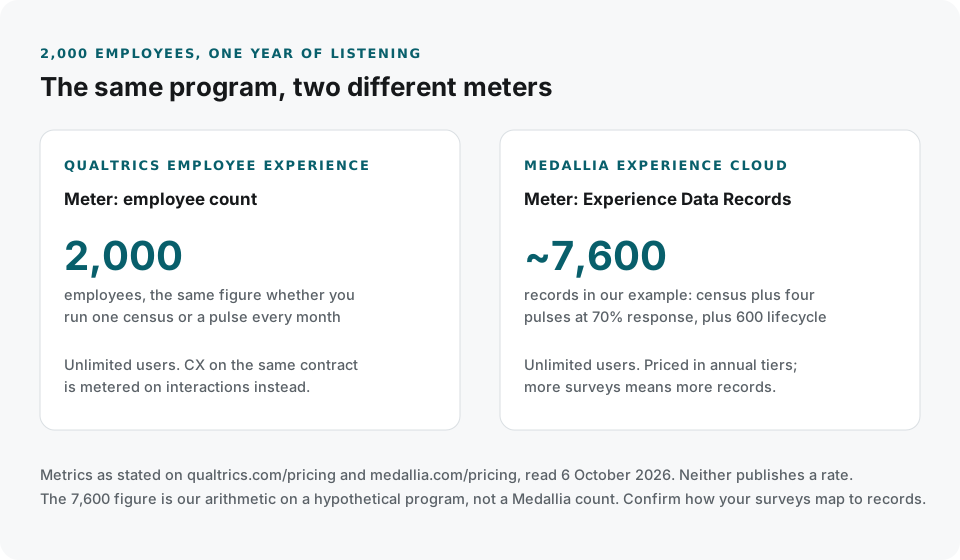
Medallia vs Qualtrics pricing at a glance
| Term | Qualtrics | Medallia |
|---|---|---|
| Published enterprise price | None. Every Employee Experience and Customer Experience package says Request Pricing | None. The pricing page routes to Talk to Sales |
| Metric for employee programs | Based on employee count | Experience Data Records |
| Metric for customer programs | Interactions, at blended rates set per product SKU | Experience Data Records, the same metric |
| Users | Unlimited, within every product | Unlimited |
| How the price is packaged | Per product, for the usage you plan | Annual tiers on one platform, no separate contract per program or channel |
| Any price on the website | Strategic Research at $420 a month, $5,040 a year (a market research product) | No |
| Industry variation | Stated: plans may differ by industry security requirements | Not stated |
How much does Medallia cost?
Medallia does not publish what it costs. Its pricing page describes a single metric, the Experience Data Record, sold "in annual tiers", and asks you to contact sales for a figure. Medallia defines a record as all the data associated with one discrete interaction between a company and a customer or employee, and says analytics, workflows, security features and unlimited users are included in that price rather than sold as extra modules.
That last point is the part of Medallia's pitch that holds up best on paper. It says you are not charged separately for each channel, so a website survey and an email-triggered survey sit on the same meter, and you do not sign a separate contract for each experience program. If your organization runs customer, employee and digital feedback together, one tiered record count is simpler to budget than several product contracts.
How much does Qualtrics cost?
Qualtrics publishes one price and it is not the one most buyers need. Strategic Research, a market research product, is listed at $420 a month or $5,040 a year on Qualtrics' free account comparison page. Both Employee Experience packages, every Customer Experience package and the Brand product show Request Pricing with no figure. Our Qualtrics pricing page sets out each product line and its stated metric.
What Qualtrics does put in writing is useful. It says its pricing is "based on metrics you know and can forecast", that you "pay for planned usage", and that its technology is included "for an unlimited number of users". For customer programs it defines an interaction as a data record collected or processed by Qualtrics, and says different interaction types are consumed under different products at blended rates per SKU. For employee programs the metric is simply headcount.
Is Medallia more expensive than Qualtrics?
Nobody can answer that from public information, because neither vendor publishes a rate. What you can say is which bill moves with which decision. A Qualtrics employee experience quote is tied to how many people work for you, so adding a monthly pulse does not change the meter. A Medallia quote is tied to records, so on our reading of its definition every additional completed survey adds to the count. Ask both vendors to price the same written forecast and compare the two annual totals.
A worked example for a 2,000-person company
Take a US company with 2,000 employees that wants one annual engagement census, four quarterly pulses, and onboarding and exit surveys for roughly 300 hires and 300 leavers a year. Assume 70 percent of employees answer each engagement survey. This is our arithmetic on a hypothetical program, not a figure from either vendor.
- On Qualtrics, the employee experience meter is 2,000 employees. Running four pulses or twelve does not change it. Growth in headcount does.
- On Medallia, five engagement surveys at 70 percent response are 7,000 completed responses, and the lifecycle surveys add about 600 more, so roughly 7,600 records a year if each completed survey counts as one record. Doubling the pulse cadence would add another 5,600 or so.
So a program that listens often favors a headcount meter, and a program that surveys once a year for a large workforce may fit comfortably inside a low record tier. Before you accept either quote, get two things in writing: exactly what counts as one record or one interaction for your survey types, and what happens when you exceed the planned volume. Overage terms are where usage-metered contracts surprise people in year two.
Medallia or Qualtrics for employee experience?
Qualtrics is the stronger pick when employee experience is the main purchase. It sells a dedicated Employee Experience suite with engagement, pulse, lifecycle, 360 development and retention analytics, priced on a meter that does not punish frequent listening. Medallia is the stronger pick when customer experience is the main purchase and employee listening rides on the same platform, because one record meter across both programs and every channel is easier to run than two Qualtrics product contracts.
The buying team usually tells you which way it goes. If the request comes from HR, Qualtrics fits the job. If it comes from a CX or contact center leader who also wants employee feedback, Medallia fits. If the customer side is mostly back-office work, such as onboarding paperwork, billing disputes and support queues, a platform built for customer experience operations may handle that part better than either survey suite, and the listening contract can shrink to the employee program alone.
What to ask before you sign either contract
- The metric applied to your program, in writing. For Qualtrics, the employee count used and how growth is billed mid-term. For Medallia, which of your survey types count as a record and how partial responses are handled.
- The tier boundaries. Where the next Medallia tier starts and what it costs, and for Qualtrics the interaction rates on each SKU on your order form if customer products are included.
- Overage and true-up terms. What happens if you exceed planned usage, and whether unused volume carries over.
- Services. Implementation, consulting and success management are often a large share of year one on both platforms. Ask for them itemized.
- Term and renewal. The length of the agreement, the renewal uplift and the notice window.
Cheaper options if you only need employee surveys
Both platforms are built for enterprise programs that span customers and employees. If you only need employee listening, several rivals print a rate you can check before a sales call. Microsoft lists Viva Glint at $2.00 per user a month with a Microsoft 365 enterprise subscription required, and Lattice, 15Five and Leapsome each list engagement surveys at $4 per employee a month. Our Qualtrics competitors page reads eleven rivals at source and works out year one at 500 employees, and Glint vs Qualtrics pricing runs the Microsoft card against a Qualtrics quote. For the frontline-heavy enterprise alternative, see Qualtrics vs Perceptyx.
Find out what the survey program should measure first
A six-figure listening contract assumes the answer is in how employees feel. Sometimes it is. Often the drag on a company is a process nobody owns, tools that do not talk to each other, or a skills gap after a reorganization, and an engagement survey will measure the frustration that results rather than its cause.
AssessmentCloud scores the whole company across culture and engagement, process maturity, digital maturity, skills gaps and compliance readiness, and returns one 0 to 100 report against an industry median. It is not a continuous listening platform and does not replace Medallia or Qualtrics for that job. It costs a flat $49, $119 or $279 a month with no per-employee meter, so you can run it before the enterprise negotiation and walk in knowing which dimension the money should go to. See the plans and start today.
We are not affiliated with or endorsed by Medallia or Qualtrics, and we do not resell either. Pricing terms change, so confirm each one on the vendor's own page before you budget.
RUN IT, NOT JUST READ IT
Score this dimension for your company
The interactive sample readout on the homepage shows exactly what you get: scored dimensions, industry benchmarks, and a prioritized action plan. Flat pricing from $49 a month.